- AI with Kyle
- Posts
- More scary than sharks

Want to know more about running AI trainings for businesses?
Next week Tuesday and Thursday I’m running live webinars to walk you through the details.
You can find out more + register (free) here:
A few months ago, my friend Hannah was organising a conference. She'd booked me to run an AI workshop for her attendees.
The day before, she messaged me the final numbers: 72 people.
My response? "72! Small! That's good, I don't need to get all worried."
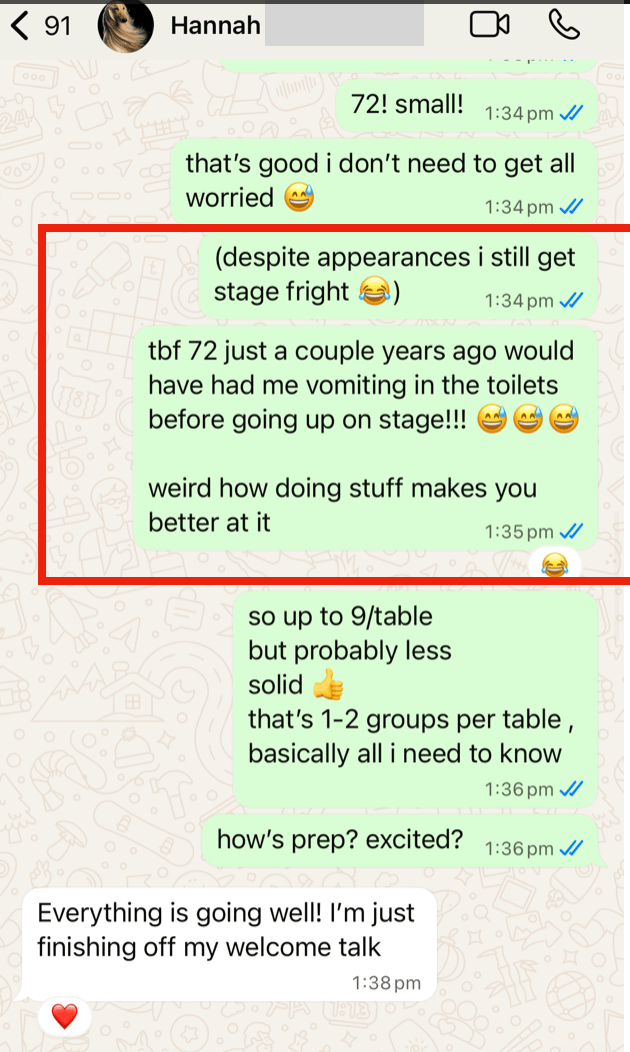
But…. just a year ago 72 people would have had me vomiting in the toilets before going on stage. I'm not exaggerating.
I'm introverted. I hated public speaking. On camera and off. I’d come out in cold sweats, stumble over my words, pure panic response.
And now? I do daily livestreams for an hour or so. I post videos on social media constantly. I've stood on stage in front of hundreds of people.
This is new. Very new. And if I can do it, so can you.
The Confidence Ladder
You don't go from zero to keynote speaker overnight. You climb a ladder.
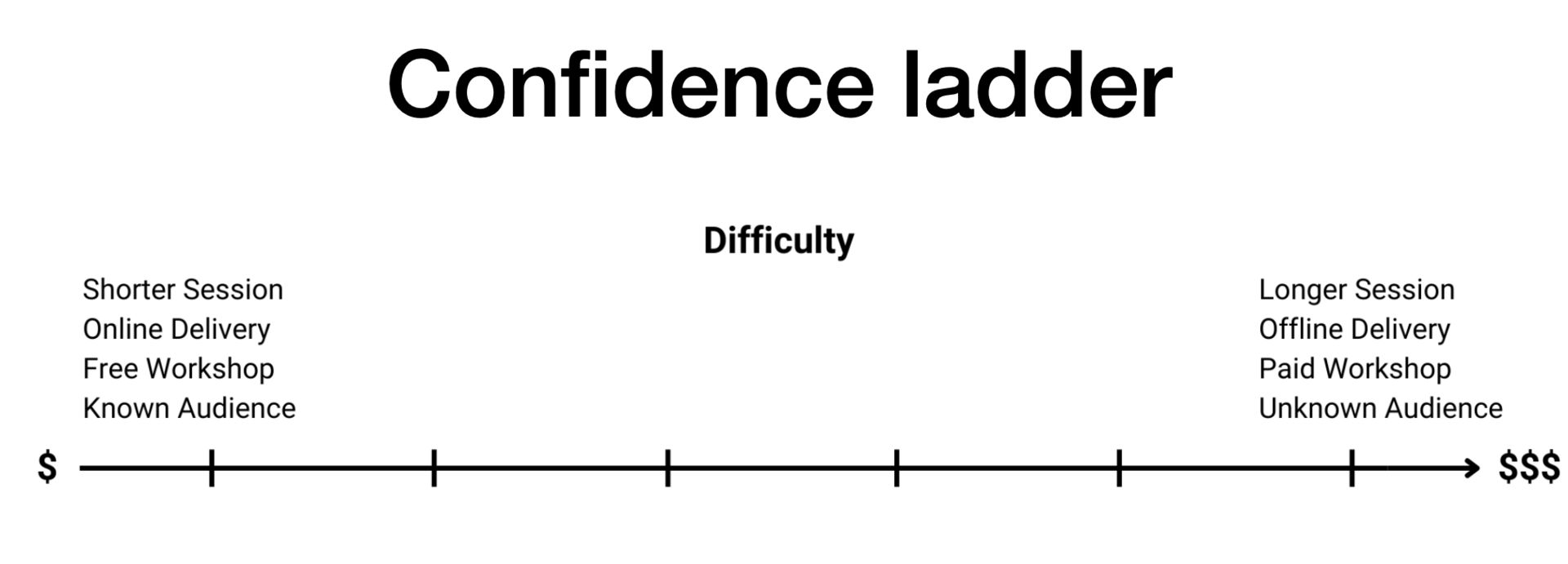
The ladder scales with both difficulty and money.
On the easy end (low difficulty, low pay):
Shorter sessions
Online delivery
Free workshops
Known audience
On the harder end (high difficulty, high pay):
Longer sessions
Offline/in-person delivery
Paid workshops
Unknown audience
Like most things the harder it is the more you’ll be rewarded. Funny that.
The “secret” here is pretty obvious: start on the left, work your way right.
That’s it.
Here’s an example “progression” combining these elements:
Rung 1: Online, Free, Small, Familiar
Record a 2-minute video explaining one AI concept. Post it on LinkedIn, TikTok or wherever. Doesn’t matter - this is exposure therapy. Or offer to do a 15-minute AI demo on Zoom for your team at work. People you already know. Low stakes.
Rung 2: Online, Free, Small, Unfamiliar
Offer a free online workshop to a community you're not part of. A local nonprofit or charity. A professional association. A friend's company. New audience, but no money on the line reduces pressure.
Rung 3: In-Person, Free, Small
Same thing, but now you're in the room. This is where you learn to read body language, handle tech issues, and manage the energy of a live audience. You’ll be physically there which raises the stakes.
Rung 4: Paid, Small
Your first paid gig. Maybe $500. Maybe $1,000. Small group. 10-20 people. This is the breakthrough moment. Once you've been paid once, you're a professional.
Rung 5: Paid, Large
Bigger audiences. Higher fees. But by now, you've got reps. You've done this before. The nerves don't disappear, but they become manageable.
Don't skip rungs. Each one builds confidence for the next. We tend to want to go straight to the end because that’s where the big money is. Don’t. Work your way there. Put in the time and effort rather than chasing the cash.
You can 100% do this as long as you go step by step.

Workshops ≠ Keynotes
Super important if you are still wary: a workshop is not a performance.
It should not be all eyes on you. Quite the opposite.
You're not standing on a TED stage delivering a memorised 18-minute talk to a silent audience. You're in a room with people who have questions, and you're helping them find answers.
The best workshops are interactive. You ask questions. They answer. They try things. You help. You walk around the room. You troubleshoot. You chat.
I spend less than 50% of my workshops actually “lecturing”. The rest is exercises, group work, shares, Q&A. It’s about them not you.
Practice Your Translation
The very best way to practice talking about AI is to…you guessed it…talk about AI.
We can’t wait for an audience though. We can and should start practicing today.
In the next few minutes you can reach your audience and start educating them on AI.
Using your phone. That little thing has a broadcast ready camera inside of it. And apps that let you potentially talk to a million people.
The only barrier to starting to talk about AI are you own emotional blocks. Fear specifically.
The best way to get comfortable is to practice explaining AI in your audience's language. The more you do it, the more natural it feels.
Use the Industry AI Translator below. Input your niche, and it will help you generate:
Analogies that make sense to your specific audience
Metaphors that reframe AI from scary to familiar
Simple explanations of technical concepts in plain English
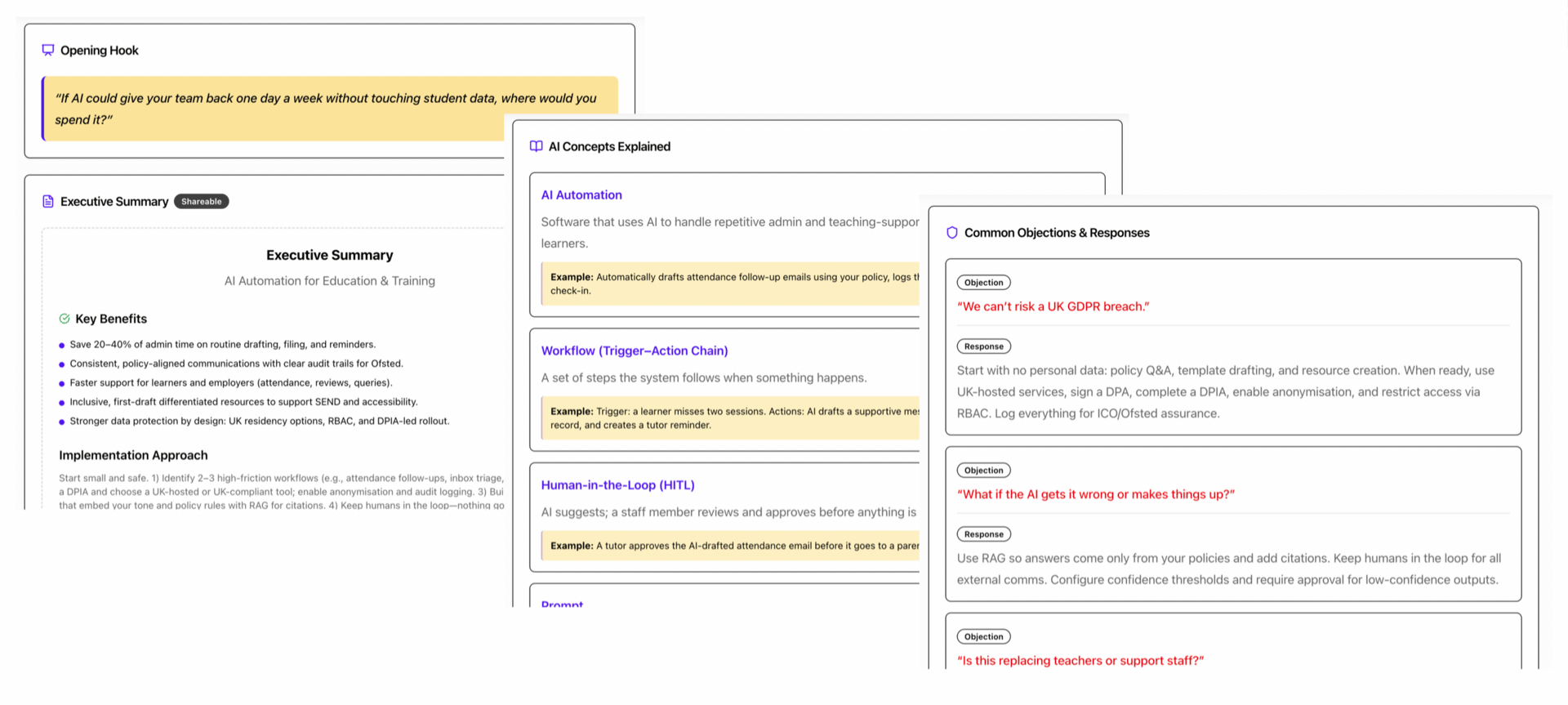
This tool will take your specifics and spit out an entire briefing for you.
Take one of these concepts or common questions and shoot a video on it. Talking head. No editing. Don’t overthink this process. Then post it. Doing this will put you ahead of 95% of the competition. Most people will never do this.
But this is the fastest way to get micro-practice explaining AI by, yes, explaining AI!
This is stuff we cover in a lot more detail in the AI Workshop Kit, as well as giving you practice videos to shoot and a community space to get feedback and improve.
Tomorrow we’ll pull all this together and talk next steps - getting you your first workshops and launching into 2026 with a bang!