- AI with Kyle
- Posts
- You Don't Need "Made With AI" On Everything
You Don't Need "Made With AI" On Everything
The EU's new transparency rules are more specific than that.

Kyle Balmer
August 12, 2026

Full video here
Do you now need to put "Made with AI" on every image, post and video?
Nope.
The EU's Article 50 transparency rules started applying on 2 August. Online this immediately became: label everything AI has touched.
That is not what the rules say.
Unfortunately most people read the headline and ignore, you know, any nuance or detail.
Let’s fill that back in. Don’t worry - I’ll keep it high level!
Also…this matters EVEN IF you are not in the EU. Sorry!
I went through the full mess in Monday's video. Now I’ll give you the practical version for creators and small businesses.
And obviously: practical information, not legal advice. If your case is genuinely unclear, get somebody qualified on the phone. Don’t listen to me! 😋
First: are you the provider or the deployer?
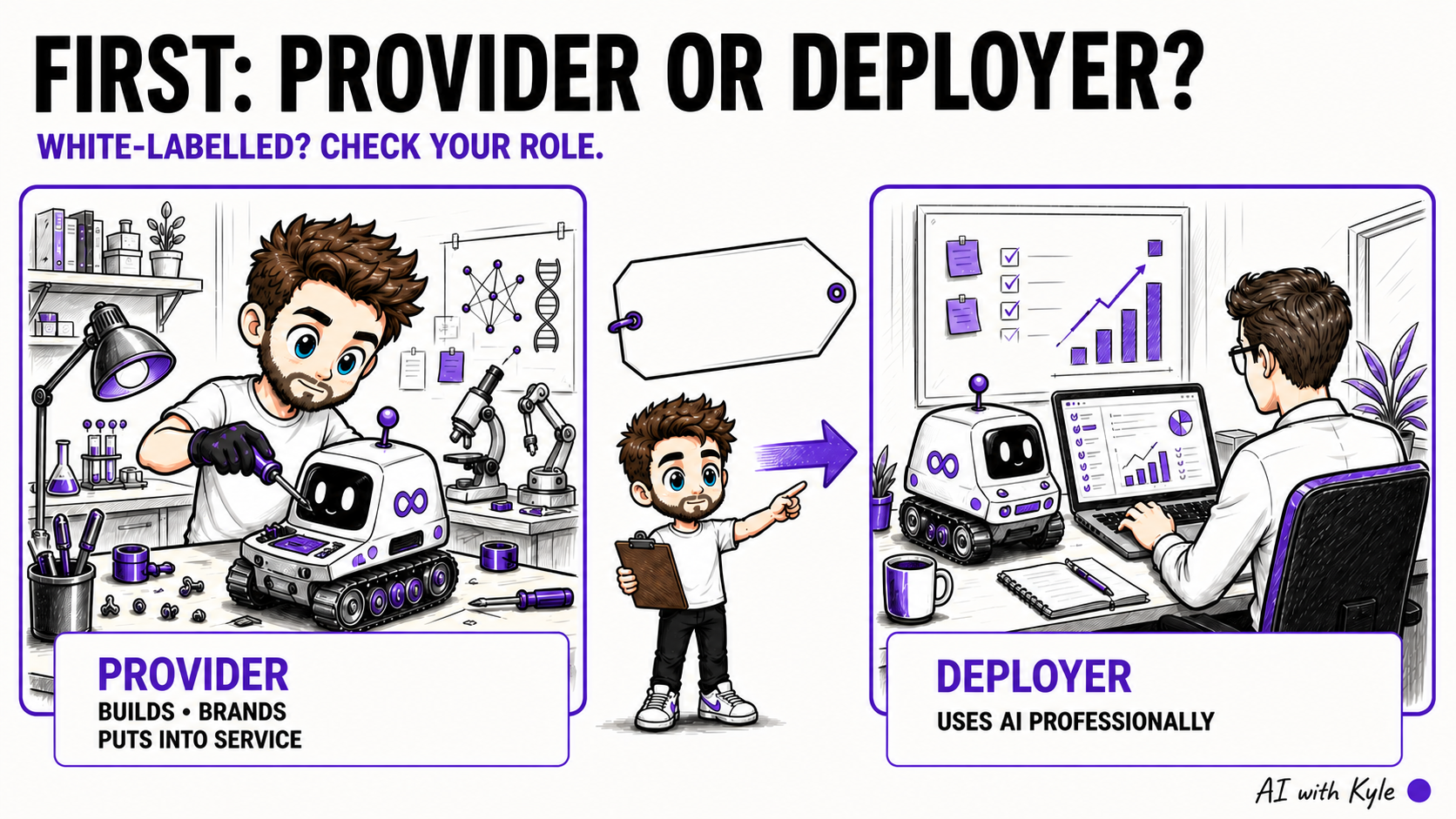
I’m seeing a LOT of confusion online and this is the main reason.
The new rules distinguish between providers and deployers. With different requirements for both.
Most people reading this are deployers.
OpenAI, Anthropic and Google provide AI systems. They are providers. If you use ChatGPT or Nano Banana inside your business, you are normally deploying somebody else's system. You are a deployer.
This distinction matters a huge amount.
The provider (OpenAI, Anthropic etc) needs to build the technical capability into the system. The deployer needs to disclose particular uses of that system to the people seeing or interacting with it.
Personal, non-professional use is also outside this particular regime. If you are sharing Shrimp Jesus memes on your personal Facebook page...carry on, I guess. You do you.
There are four big areas where we need to pay attention:

The four big areas are:
Businesses need to make it clear when their customers and users are interacting with AI
Providers need to add digital watermarks to outputs
Deployers need to visibly disclose deepfakes
Text for the public interest must be human edited.
Let’s hop into all four quickly and see which matters to you.
People need to know when they are talking to AI
First one is pretty simple. If your customers or users are using AI you need to tell them.
We’re talking inside chatbots, customer service emails, auto-DMs etc. etc.
Basically if it is not obvious that they are interacting with an AI we need to disclose this fact.
If your business installs a normal third-party chatbot, check that the provider handles this properly. The disclosure should appear no later than the first interaction - basically chuck it in your welcome message.
Critically this rule covers genuine two-way interaction with a person. A background automation moving data between two systems is not having a chat with anybody. It’s only relevant when there is a real concern that the person we are interacting with could mistake the interaction as human.
I already do this with the bots sending links on my social accounts: "Hey, this is a bot. I'm not that fast. Here's the link you asked for." Chuck one line into the welcome message. Done.
Providers need to mark synthetic outputs
The second area also sits with the provider.
This is the big one that is going viral right now because of Anthropic’s “watermarks”. More on this in the next issue.

Providers of systems that generate synthetic audio, images, video or text have to make those outputs detectable in a machine-readable way, where technically feasible.
Google's SynthID is the obvious example. A computer can inspect an image and find evidence that a Google model generated it, even when there is no visible watermark for a person to spot.
A computer reads the mark and knows its AI generated. Your audience usually won't - there’s nothing “visible” to them.
So if you are using ChatGPT, Claude or Nano Banana inside your business, you normally do not need to invent your own technical watermarking system. The model provider owns that job. This isn’t on you.
Deepfakes need a visible label
This one however is very much on you!

If you publish AI-generated or manipulated image, audio or video that qualifies as a deepfake, you need to disclose that it was artificially generated or manipulated.
That disclosure needs to be visible. On the image or in the description/captions underneath. It has to be (unlike the prior requirement) human readable.
The big question then is …. what counts as a deepfake? The test is not simply: did AI make this?
The Act describes a deepfake as content that resembles a real or plausible person, object, place, entity or event and could falsely appear authentic or truthful.
My illustrated chibi avatar? Nobody thinks that is camera footage of a tiny cartoon Kyle. Probably fine - and it does NOT require disclosure that AI drew it.
A realistic clone of my face or voice? Very different. Disclose it.
The same goes for fake footage of a real disaster, a realistic fake testimonial or a synthetic person pretending they used your skincare product. Honestly, AI UGC is a gross corner of this industry and I am entirely happy with it getting more scrutiny.
Obviously the line here is complicated. When does something become “realistic” enough to fall into deepfake territory? And how does that change as i) the models get better and ii) people become better at telling the difference. This is all messy and the current EU rules don’t really go into sufficient detail.
Important for those who are wringing your hands about freedom of speed. Context still counts. Art, satire and fiction can use a disclosure that does not ruin the work, but the duty can still apply where the content looks real enough to fool somebody.
And yes, the ordinary laws are still there. You can’t AI generate videos and then sell a fake product because fraud wis still fraud! The EU AI Act just adds more rules on top.
Public-interest text needs disclosure
This is probably the one that is most relevant to the majority - AI in text.
You do NOT need to disclose any text that has been written or manipulated by AI. That’s too much. And let’s be honest it’ll (soon) be pretty much ALL text.
Instead the fourth area covers AI-generated or manipulated text published to inform the public on a matter of public interest.

Think politics, public administration, rights, safety, health, the environment, finance and scientific developments that feed into public debate.
Your AI-assisted product description, sales email or random Instagram caption is not automatically public-interest text. An unreviewed AI summary of an election, a health policy or a financial development is much closer to the centre of the rule.
In these cases you need to disclose the use of AI.
Unless …
You give is a human edit.
Basically a proper human edit can take the text out of that disclosure duty.
If a human substantively reviews the text and a person or business takes editorial responsibility for publishing it, the Article 50 public-interest text disclosure is not required.
Substantive review means more than running Grammarly and changing three words. Somebody needs to examine the argument, check the facts and sources, change or reject weak copy, then put their name or business behind the finished version.
The big thing here is that a human is taking responsibility for the text and basically saying “yup I own this”. It’s a legal fix.
FYI this is basically how this newsletter works. I talk through the issue live on stream to get the raw content. AI turns the transcript into a first draft. Then I rewrite it, fact-check it and approve the version you receive. Both versions are saved - the shitty first draft from the AI and then my rework.
As you can guess it’s the human Kyle who includes things like “shitty first draft”.
If you use AI for content, build the same ownership into your AI writing workflow. Keep the source, AI draft and human final together. A shared AI vault makes that record much less of a faff.
And if you are keeping records you do not need a new compliance platform for this. I’m sure there will be many companies trying to sell you some complex solution. Tell em to sling it. A Notion database or Google Sheet can record who reviewed the piece, which sources they checked, what changed and who approved publication. Honestly a system like this is needed if you are publishing decent amounts of content anyway!
So … let’s boil this down!
Before you publish, ask:

Are we the provider or deployer here? Probably the deployer but confirm this!
Is somebody directly interacting with AI, and do they know that immediately? Audit your external facing content and interactions.
Could this image, audio or video reasonably pass as something real? If in doubt err on the side of caution. Remember Shrimp Jesus.
Is this text informing the public about a public-interest matter? Most content doesn’t fall under this which means you’ll mostly be fine.
Did a human properly review it, and who owns the decision to publish? Useful to do anyway to guard against AI slop.
And remember your location is not the only test - it’s pretty unimportant. Businesses outside the EU can still fall within scope when their systems or outputs are used inside the Union.
You do not need to run back through years of old content either. The Commission says content produced before 2 August does not need retroactive labelling.
The maximum penalties can reach €15 million or 3% of worldwide annual turnover. Those are statutory maximums, not an automatic invoice for one missing label, and enforcement has to consider the circumstances and proportionality. Very likely we’ll see the EU pursue some high profile cases, make a splash, and then throttle back a bit once everyone falls in line.
Still...not a number I particularly want to test…and nor do the AI providers.
So…you do NOT need the blanket "Made with AI" stamp. Instead know which of the four duties you are dealing with, who owns it and what proof you have that the job was done. That’s it for the majority of us.
To the Task,
Kyle