- AI with Kyle
- Posts
- AI with Kyle Daily Update 166

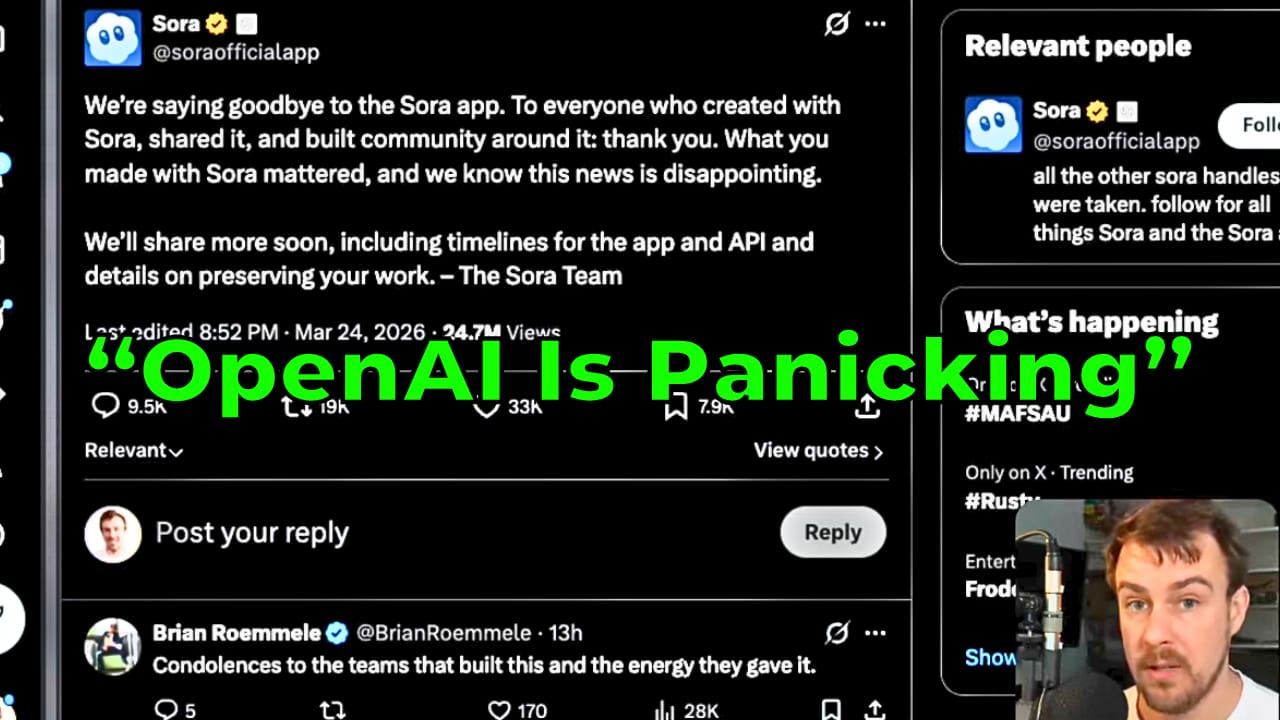
Big one today. OpenAI killed Sora. Not "deprecated" or "sunset" - killed. Graveyard dead.
And that's just the glitzy headline. The Disney deal is dead, the CEO of Applications is telling staff to stop building side projects, and the whole company feels like it's shifting gears.
OpenAI kills Sora
Sora is done. OpenAI pulled the plug on the video generation app this week. No real explanation given - just a goodbye message from the team and a promise to share timelines for preserving your work.
Quick recap on the context here: Sora was previewed in February 2024 and Hollywood lost its mind. It launched publicly in December 2024 for Plus and Pro users in the US, Canada, and a handful of other countries. Most of Europe never got proper access - Sora 1 web eventually became available in the EU and UK, but Sora 2 and the app had a much narrower country list. I put together a guide to access it with a VPN and invite codes, and my inbox blew up for weeks with people begging for codes. That hype lasted about two weeks. If that…
Then the real numbers came in. By late January 2026, Sora had 9.6 million downloads and $1.4 million in total consumer spending. Sounds OK until you remember this was one of the most hyped AI launches ever The app dropped out of the US top 100 free apps. Meanwhile, Kling, Seedance, and MiniMax (all Chinese) were shipping better video models, cheaper, with wider access.
Kyle's take: Sora had a brilliant launch - that guardrails-off first week where you could make videos using any IP was genius marketing (and super duper shady). But after the honeymoon it died off. The Chinese models were better, the pricing was wrong, and most of the world couldn't even access it. I
The Disney deal that never closed
Late last year, Disney and OpenAI announced a deal. Disney would take a $1 billion equity stake in OpenAI and licence more than 200 characters - Marvel, Pixar, Star Wars - for use in Sora. The plan was basically Fortnite for AI video. Companies licence their characters into the platform, users generate content, everyone shares the revenue.
It was smart thinking from Disney. They're losing the attention war. Kids aren't sitting through two-hour films anymore - they're on TikTok. So Disney's play was to control AI-generated short-form content using their own IP, in a safe, moderated space. A TikTok-like feature inside Disney+, powered by Sora. Smart.
But the deal never actually closed. Reuters reports no money changed hands before OpenAI pulled the plug. The Disney lawyers were still going through their processes while OpenAI shipped and killed an entire product.
Disney says they're still interested in AI and will "continue to engage with AI platforms." Translation: they're on the phone to Google right now. Gemini has the video capabilities, YouTube has the distribution. Apple could be in the mix too given the Pixar connection, but they don't have the models. I don't see Disney licensing characters to Chinese platforms, so it's basically Google's deal to lose. Good job Google!
Kyle's take: This is what happens when old-school companies try to move at AI speed. It took three months for a Japanese content trade group representing Studio Ghibli to send a stern letter about Sora. The Disney deal was inked late last year and still hadn't produced anything six months later. These companies aren't slow because they're stupid - they're slow because they're massive and not used to the pace of change. Legal reviews, compliance, approval chains. In AI, six months is three lifetimes.
"Stop doing side quests"
Fidji Simo - who joined OpenAI in May 2025 as CEO of Applications - told staff last week that the company "cannot miss this moment because we are distracted by side quests." She said executives are actively looking at areas to deprioritise.
Someone on Twitter nailed it: "Stop doing side quests is the most devastating thing a CEO can say to a room full of researchers." Side quests also include things like, I dunno, safety research.
And they're right. If you're an AI researcher who wants to push boundaries, build cool stuff, explore what's possible - being told "cut that shit out, we need to make money" is brutal. But from a business perspective, it makes total sense.
Look at the data. OpenAI's consumer subscriptions bring in over $5 billion. That's massive. But it's 900 million plus users generating that revenue - huge overhead, fickle customers who cancel when they're angry about a Pentagon contract. Meanwhile, Anthropic has maybe 30-40 million users but their API revenue actually competes with OpenAI's. Enterprise customers sign big contracts. And they don't leave because of a trending hashtag.
OpenAI has a high volume, low margin business. Gross.
Anthropic has a low volume, high margin business. Yum.
So the pivot makes sense: cut the flashy stuff that doesn't make money (Sora, shopping experiments), double down on API, enterprise, and coding. You know, where the money is. Prop up consumer with advertising. Get ready for the IPO. Show investors you've got a real business model. Not just viral Sora videos.
Kyle's take: I think Fidji's doing exactly the right thing. But it's going to make ChatGPT less fun. Expect advertising on the free plan. Expect fewer cool experimental features. Expect more focus on Codex, the API, and enterprise tools. OpenAI's best recent product is Codex - that team is genuinely knocking it out of the park. Everything else? I'm not sure what they're working on. Their current pinned post on X is GPT 5.4 from 20 days ago. In AI, 20 days is a long time to have nothing new to show…
Anthropic isn't slowing down
While OpenAI staff are being told to cut back, here's what Anthropic shipped in just the last two months: Cowork, Opus 4.6, PowerPoint integration, Excel integration, Cowork plugins, Claude Code security, remote control, scheduled tasks, connectors on free, memory on free, Marketplace, Community Ambassadors, code review, skills for Excel and Slides, charts and diagrams, 1 million context window, Dispatch, Code channels, Cowork projects, and just two days ago - Claude Computer Use.
That's not a typo. That's just the last 2 months. Hell, as I’m writing this I see they’ve just dropped a new tool usage function in-app. And some of these are massive - the jump from 200K to 1 million context window alone would've been headline news from anyone else.
Compare that to OpenAI's recent output: GPT 5.4, a search bar in ChatGPT's library, and Codex for students. That's about it.
Kyle's take: This is the shipping gap. Anthropic are building in public, getting feedback, iterating fast. Some of it's rough - remote control is still a bit rubbish - but at least they're putting it out there. OpenAI hired Peter Steinberger, the Open Claw creator, and he's presumably building something amazing in secret. But while he's working in secret, the Claude team are shipping, shipping, shipping. Every day there's something new. I'm very bullish on Claude right now.
Q&A picks
"Is the Claude Ambassador program good?"
Looked into this on stream. It's a community program - you host local meetups and events for Claude users in your city. No direct payment, but you get event sponsorship, API credits (that's the big one), swag, and you can talk about it publicly.
You don't need to be a developer - just meaningful experience with Claude Code or Cowork and a track record of community involvement. It's global and you can be an ambassador for other companies, just not direct Anthropic competitors.
I was going to apply for Nicosia, Cyprus, since I'm moving there shortly. Ideally with a Cypriot co-organiser!
"Thoughts on Open Claw vs Cowork w/ Dispatch?"
Covered this extensively. Short version: Open Claw is more powerful but riskier. Cowork does about 90% of what Open Claw does in a 90% more secure way. If you're comfortable with the command line and security hardening, Open Claw is fantastic. If you just want an assistant that works when you toggle it on, Cowork plus Dispatch is the one.
Kyle