- AI with Kyle
- Posts
- AI with Kyle Daily Update 138

What’s happening in the world of AI:
Highlights
What Can You Actually Use Open Claw For? (The Practical Guide)
Not much AI news worth covering, so instead I did something a bit different: a full walkthrough of what OpenClaw (formerly ClawdBot) is actually useful for in your daily life and business. Because right now, a lot of people are in the same place they were two years ago with ChatGPT: they know it's a big deal, they can see the hype, but they're not sure what to do with it. FOMO is real.
My mum asked me on Friday how to set up ClawdBot. I told her not to. And that's a perfectly valid answer for a lot of people. But if you're running a business, doing knowledge work, or building anything, this is worth understanding.
Quick context on where OpenClaw is right now: 185,000 stars on GitHub. It's tracking to overtake Linux's star count within the year, which is madness
for a project that's existed for a few weeks. Meetups are happening in Vienna, San Francisco, and elsewhere, with people getting together specifically to work out what to build with it. The showcase page has about 50 examples, but there's far more happening out in the wild.
Here's how I've been thinking about the use cases, broken into four pillars.
Pillar 1: The Executive Assistant

Think about this as if you were hiring an assistant. Literally, as if you were onboarding a human assistant.
What tasks would you hand off? Invoices, receipts, bookkeeping, purchasing, scheduling. Boring stuff that eats your time.
Take the same amount of time working this out for OpenClaw as you would if you just hired a £50,000 salaried executive assistant.
The key difference between OpenClaw and just using ChatGPT for these things is that OpenClaw is always on. It's proactive rather than reactive. You don't go to it with a task. It picks up tasks based on triggers and gets on with them. That's the mental shift: from "I go to the AI when I need something" to "the AI handles things before I even think about them."
So…you need to work out what you want your assistant to be on top of. What should it be checking in on, working on in the background, reporting to you?
What’s a negative example? A daily weather report. I’ve seen so many people showing off their OpenClaw daily brief which tells them the weather and what they have on that day.
Guys. A calendar app can do that. You don’t need OpenClaw for that!
The weather report example keeps coming up, and on its own it's pointless. You can open a weather app. But when the weather report triggers a schedule adjustment, which moves your run to a better window, which updates your productivity blocks, which connects to your nutrition tracking, that's when it gets clever. It's not about individual tasks. It's about the connectivity between systems flowing through one central orchestrator. This is where use cases get very interesting.
Some of the more interesting executive assistant uses I've seen: a job search agent that autonomously monitors listings, matches them to your CV, and drafts applications. Receipt logging where you photograph a receipt and it automatically gets categorised and pushed to your accounting software. The "Karen skill," which drafts and sends formal complaints to customer service on your behalf. Padel court booking. Accounting intake that collects PDFs from emails and preps documents for your tax consultant. Smart home control via WhatsApp so you can ask "did I leave my front door open?" from anywhere.
None of these are individually revolutionary. Most have existing apps that do something similar. The point is having them all flowing through one system that can make connections between them.
Pillar 2: The Researcher

This is what I use Open Claw for most. It grabs AI news every morning based on criteria I've defined: what I want, what I don't want, specific sources, limitations. It delivers the results to me before I've finished my coffee. Could I have built a cron job for this? Yes. Is it easier with OpenClaw? Much.
The real power is that it's proactive research, not reactive. With ChatGPT deep research or Claude deep research, you go to the tool, set up a query, wait, and get results. Cool. Does the trick. But I don’t want to keep having to do that daily.
With OpenClaw, the research happens when it needs to, triggered by events in your ecosystem. I'm hosting a conference at the moment. When an interview is confirmed and hits my calendar, that could trigger OpenClaw to automatically go deep on the person I'm interviewing: their background, their work, what's relevant to the conference topic. By the time I sit down to prep, the research brief is already waiting. I’m not needed to process the research each time.
That's the paradigm shift. It's not an AI you go to when you have a research question. It's a researcher on your staff who proactively does the work when it's needed.
So again think about how you would instruct and work with a human research assistant. Would you have them sitting on their hands waiting for you to come with questions? No. That’s a waste. But that’s what we do with ChatGPT.
Instead you’d give them long term, medium term and short term tasks. And a priority and decision making criteria to work through them. And then you’d set them to work.
Pillar 3: Marketing and Ops

This is where I'm most excited and, embarrassingly, haven't set up that much of yet!
An example. Press and PR. When a journalist comes to me with a question I always answer. Just yesterday some of my answers appeared in TechRadar talking about the end of GPT-4o. Here’s the article if you want to check it out.

I did that because the journalist reached out and ask. I wasn’t proactive. She was! (Btw she talks about very interesting topics connected to AI on her socials: Becca Caddy. Go give her a follow for me! )
But what if I set up an OpenClaw agent to go and proactively find me these opportunities? The potential for a PR agent alone is massive. I've talked to PR agencies, and a lot of what they do for a couple of grand a month is: send outreach emails, monitor Help A Reporter Out for relevant opportunities, and manage relationships. 1000% they do more than that and I’m being a little unfair. But not that much more…
OpenClaw could handle the research and initial outreach, find who's writing stories in your space, identify the right contacts via LinkedIn, start conversations, and then hand off to me when it gets to the point of actual human relationship-building.
I’ll add this to the list to build! 😁
Another example - for ad management, I'm currently running a Meta campaign with 90 video variations. I can OpenClaw access to the Meta ads MCP, have it monitor performance, check A/B tests, refresh copy when things go stale, and deliver a weekly report saying "these three hooks are outperforming, you should shoot more like this." It becomes an always-on marketing analyst that works weekends. Again, that would normally cost me a few thousand a month to hire an agency.
Content repurposing is another obvious one. These lives become newsletters, which become website guides, which become slide decks, which become short-form video scripts. All of that pipeline could run through OpenClaw, triggered by each live session ending.
The possibilities are basically endless once you start thinking about the tasks you want to get done.
Pillar 4: The Junior Developer
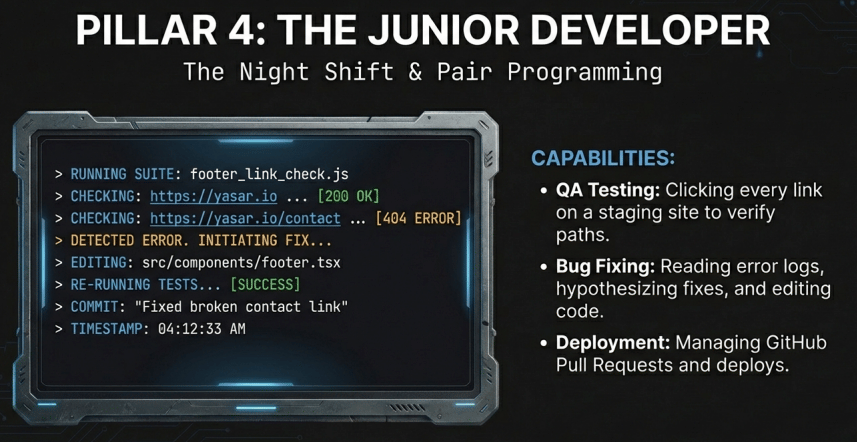
If you're already vibe coding (or as we're now calling it, “agentic engineering”…nice try Andrej!), OpenClaw takes it a step further. Instead of sitting with Claude Code or Cursor, going back and forth every few minutes, you give Open Claw its own GitHub account, its own Vercel deployment, its own Supabase access, and a wider brief. It builds, tests, checks PRs, handles deployment, and troubleshoots when things break. You step away entirely…
Ryan Carson (founder of Treehouse, which educated over a million students before being acquired in 2021) put it well: "Holy shit, I have truly seen the light with Open Claw. This is not a toy or a shiny object. This is how you will hire engineers in the future." He set it up on a separate iMac with its own GitHub account and Vercel account, and it's shipping real PRs for him. His key insight: "Having something that is actually an agent versus something you invoke truly changes the calculus."
I'd push his point further. It's not just engineers. This is how we're going to hire researchers, copywriters, marketing analysts, PR assistants. The model is the same: define the role, give it the tools, set the boundaries, and let it work.
Update…he said the same thing just today! We’re on the same wavelength!
The risks with the developer use case are real though. At best, you burn through thousands of credits fast. At worst, it creates something insecure or leaks API keys. The Open Claw creator strongly recommends using Anthropic's Pro or Max plan with Opus 4.6 for better prompt injection resistance. Anthropic themselves would prefer you use the API rather than routing your subscription through OpenClaw, and may block accounts doing this. I'm doing it anyway. Don't tell them. Shh. (Sorry Ryan if you are reading this!)
One More Thing: The Minecraft Dad
My favourite use case is totally non-work related but again gives an idea of the sheer BREADTH of what we are talking about here. It’s a dad who uses Open Claw to manage his kids' Minecraft server. When they get lost in the Nether and message him at work, he talks to Open Claw via WhatsApp, which relays console commands to teleport them back together. Even when he's not home. This would never occur to you unless you had this specific problem, and that's exactly the point. The use cases aren't generic. They're deeply personal to your life and work. And now we can just spin up solutions via Whatsapp or Slack.
Management Is the New AI Superpower
Related to all of this is a vital point made by Ethan Mollick. Increasingly it’s our ability to delegate and instruct that is key. Not our ability to do the work itself. But the ability to oversee it.
Ethan Mollick published a piece arguing that management is the superpower for the AI age. If you can run teams, delegate tasks, write clear briefs, and structure projects, you're going to thrive with agents and agent swarms. Because that's what this is now: managing a team of digital employees.
The interesting flip is that this is a skill a lot of technical people don't have. If you've spent your career as an individual contributor working with a computer, you may never have managed other human beings. Meanwhile, people from non-technical backgrounds who've led teams, written SOPs, and structured work for others are suddenly in a very strong position.
Think of every Open Claw setup as writing a job description, then onboarding an employee, then managing their output. That's the skill set.
The People Who Love AI Most Are Burning Out First
A UC Berkeley study published in Harvard Business Review found that AI is not reducing how much people work. It's increasing it. Researchers spent eight months inside a 200-person tech company and found that nobody was pressured to do more. People just started doing more because the tools made more feel doable. Work bled into lunch breaks and evenings. To-do lists expanded to fill every hour that AI freed up, then kept going.
I'm finding the same thing personally. I'm rebuilding a 4.1 million pound government website as a side project purely because AI made it feasible. Previously it would've been months of work that I'd never start. Now it's 10-20 hours and I feel like I have to do it because I can. Multiply that across every idea and project and you start to understand the burnout.
There's a FOMO and scarcity driving this. People who've realised they can build anything are working harder than ever because they know the window is limited. Before AGI, before everyone else works it out. So paradoxically, the people who understand AI best are not working less. They're burning the candle at both ends.
I don't have a solution for this one. I'm part of the problem. But it's worth being aware of the dynamic. AI gives you the ability to do the work of 1.3 people. Your brain notices. Now you're doing the work of 1.3 people permanently. The tool that was supposed to buy you breathing room instead raised the floor.
Member Questions:
"Could I make a trading bot with OpenClaw?"
Kyle's response: You could. I wouldn't.
There will be a lot of people selling you the idea that you give Claude Bot a hundred quid and wake up with two-fifty. Be extremely careful when anything sounds too good to be true. The people making money are the people selling the system, same as it's been with trading schemes for centuries. If you're an experienced trader who's already systematised a working strategy, maybe you could encode that into Open Claw. But if you're starting from "here's my Robinhood account, make me rich by Friday," it's not going to work.
"Can I run Open Claw on Windows with Kimi K2 locally?"
Kyle's response: Yes to Windows - there’s a powershell installer. The Kimi K2 part is where it gets expensive. The full non-quantised version needs eight H200 GPUs, which is about a quarter of a million in hardware. Oh and you’ll need some RAM too…which ain’t cheap.
You can run quantised versions with less, or rent H200s for about $3/hour per GPU on a cloud service, which brings it down to hundreds rather than hundreds of thousands. For most people, connecting Open Claw to a frontier API model (Claude, GPT) is more practical than running local. LM Studio is a good starting point if you want to experiment with smaller local models.
Want the full unfiltered discussion? Join me tomorrow for the daily AI news live stream where we dig into the stories and you can ask questions directly.