- AI with Kyle
- Posts
- AI with Kyle Daily Update 116
AI with Kyle Daily Update 116
Today in AI: Google Engineer's Claude Code Confession + Why Even Non-Coders Should Care

Kyle Balmer
January 06, 2026
The skinny on what's happening in AI - straight from the previous live session:

Highlights
Happy New Year! The past couple of weeks have been pretty quiet on the AI news front - as expected over the holidays.
What has happened is that Claude Code has suddenly become the topic of conversation. If you spend any time on Twitter or Reddit, you'll have seen it. Everyone's talking about it.
The short version: Anthropic released Claude 4.5 Opus, their most powerful model yet, and it's made Claude Code genuinely exceptional.
I want to use this issue to give you a quick summary of why you should care about Claude Code. Even if you are not a coder!
🚀 A Google Engineer's Confession
Here's the story that got everyone's attention. Jaana Dogan is a Principal Engineer at Google. She works on the Gemini API - so this is someone who knows what she's doing. She's not some random dude on the internet with an opinion.
She posted on X: "I'm not joking and this isn't funny. We have been trying to build distributed agent orchestrators at Google since last year. There are various options, not everyone is aligned... I gave Claude Code a description of the problem, it generated what we built last year in an hour."
Let that sink in.
A year's worth of work at Google - one of the most advanced tech companies on the planet - replicated in an hour by an AI coding tool built by their competitor.
Kyle's take: What makes this genuinely significant is who's saying it. This isn't marketing material from Anthropic. This is a senior Google engineer, publicly praising a competitor's product. She clarified that Google's team had been going back and forth on different approaches, and there was internal disagreement about the best solution. Claude Code just... did it. No fuss, just here you go.
Now, she did add context - it was a "toy version" based on three paragraphs of description, and it needed refinement. But the core architecture? She also mentioned that if you aren’t a coder then try it in YOUR domain - this is so important, because Claude Code isn’t just for code.
💡 Why This Matters Even If You Don't Code
Claude Code is for coders right? I mean, it’s right there in the name?
Nope- anyone working on a complex project can (and should!) be investigating Claude Code to help them out.
Look at this example from Pietro on X: he fed Claude Code his raw DNA data from an ancestry test - just a massive CSV file - and used it to find health-related genes he should keep an eye on. That file would choke ChatGPT. But Claude Code worked out how to chunk it up, what to look for, and built the analysis tools on the fly.
Ethan Mollick from Wharton put it brilliantly: "When you see how people use Claude Code, it becomes clear that managing agents is really a management problem. Can you specify goals? Can you provide context? Can you divide up tasks? Can you give feedback? These are teachable skills."
Kyle's take: Claude Code can help you with any complex task.
Writing a book? Planning a curriculum? Analysing a data set?
Claude Code can assist with any and all complex tasks you throw at it. People are trying to find its limits and (for the most part) failing. This is about what we as humans can imagine - what problems can we solve? It’s our imagination here that is the limit, not necessarily the AI.
Importantly, it's not about knowing Python or understanding C++. It's about being able to manage, to think in systems, to set tasks clearly. Those are skills most business owners already have. The actual coding bit? Claude handles that.
You're the manager now.
🛠️ Three Ways to Access Claude Code
If you've ever been to the Claude Code website, you've probably seen the installation instructions that look like gibberish to anyone who's not a developer. Something like curl -fsSL https://claude.ai/install.sh | bash - and if you've never touched a terminal in your life, that's a wall.
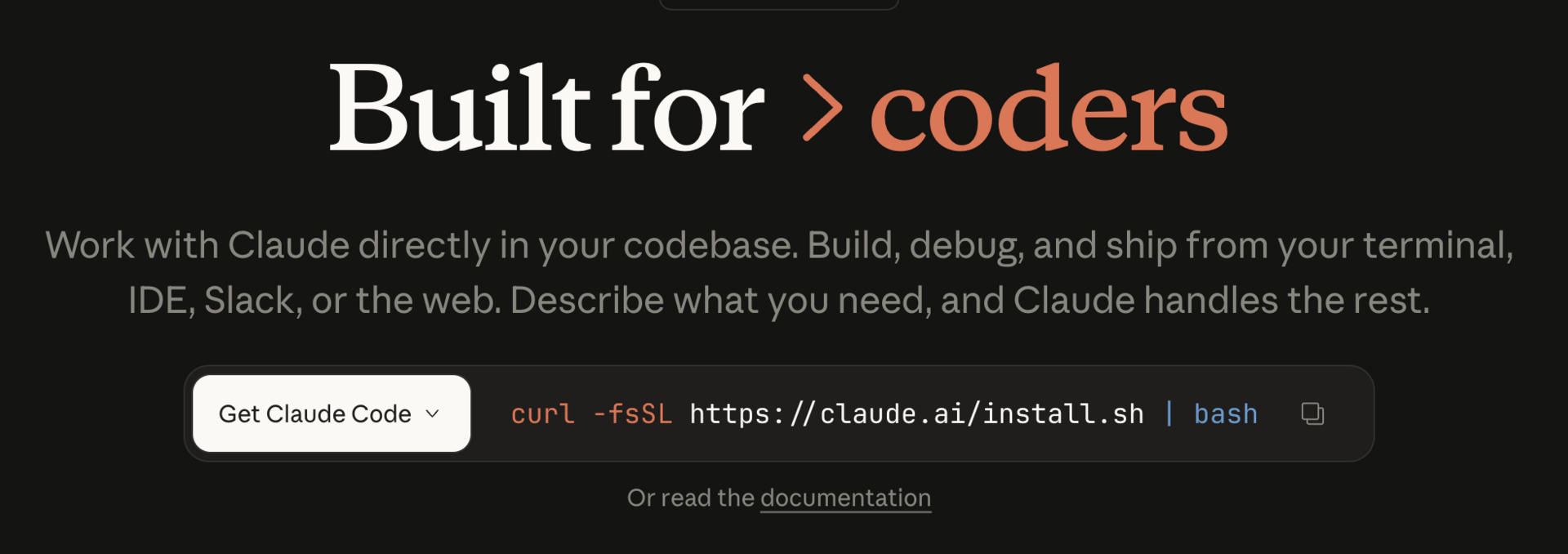
Terrifying
This is a shame. Claude Code is currently only available for the tech-savvy. When we need to get it into the hands of anyone dealing with complex tasks. Thankfully there are other ways to get it working for you.
Here are your three options:
Option 1: The Terminal (Most Powerful, Most Intimidating) If you know what a command line is, if you remember DOS, if you're comfortable with that black screen with text - this is the most powerful way to use Claude Code. You copy that installation command (that curl -fsSL stuff from above) , paste it into Terminal (Mac) or Command Prompt (Windows), and you're away. It’s actually not hard but requires you to be comfortable with the terminal.
Option 2: VS Code or Cursor (Middle Ground) Visual Studio Code is free, open-source, and gives you a proper development environment. You can see your files, your folders, everything laid out visually. Then you install the Claude Code plugin and you're working in a much more friendly interface. An alternative to VS Code is Cursor (which is what I personally use). Cursor is similar but costs £20/month. Both VS Code and Cursor can run Claude Code inside them, with a more user-friendly interface.
Option 3: The Web Version (Easiest, But Less Powerful) Here's the good news - you can now use Claude Code directly in your browser at claude.ai. Specifically at http://claude.ai/code. You'll need a paid plan and a GitHub account (which is free to set up), but then you've got something that looks and feels like ChatGPT. It's not quite as powerful as the other methods, but it's a brilliant starting point.
Kyle's take: Start with the web version if you're intimidated by the technical stuff. Get comfortable. Understand what Claude Code can do. Then, once you're ready, move to VS Code. The power difference is noticeable, but accessibility matters. Don't let perfect be the enemy of good!
📊 How Boris (The Creator) Actually Uses Claude Code
Boris Cherny literally built Claude Code. He works at Anthropic. And he shared how he uses it - and it's surprisingly vanilla. I recommend reading the whole tweet:
Claude can be customised up the wazoo. And a lot of people spend a huge amount of time “perfecting” their particular usage of it. Boris is saying…don’t bother.
He personally runs 5 Claude sessions in parallel in his terminal, numbered 1-5. He also runs 5-10 more sessions on the web version at the same time. So that's potentially 15 Claude Code instances all working for him simultaneously. He uses system notifications to know when a session needs input.
What he’s doing here is not complex - it’s more about volume. He just uses a LOT of Claude Codes all running together. So as to increase his productivity.
His key insight? "Probably the most important thing to get great results out of Claude Code - give Claude a way to verify its work. If Claude has that feedback loop, it will 2-3x the quality of the final result."
And here's the fascinating bit: they develop Claude Code using Claude Code. Last month, Boris landed 259 pull requests - that's 40,000 lines of code added and 38,000 removed - and every single line was written by Claude…
Member Questions:
Member Question from the Live Chat: "Do you think professional writing and professional prompt writers would be paramount over developers?"
Kyle's response: No, I don't think prompt engineers will replace developers. What's happening is developers are learning to prompt better as part of their existing workflow. The code-writing part of development is becoming automated, but software development is much bigger than just writing code.
You still need to work out what to build. You need to understand the architecture, the structure, which components need to connect where. You need testing. And critically - you need to build something people actually want. That's the marketing element that everyone forgets. So developers aren't going away; they're just operating at a higher level of abstraction.
Member Question from the Live Chat: "I've made an app in Lovable. I now need to figure out how to make it a mobile app."
Kyle's response: So Lovable is brilliant for web apps - things that live in a browser. But it's not really built for native mobile apps. What you'll want to look at is Capacitor. It's a tool that takes your web app and converts it into something that can run on iOS and Android.
The good news is you can talk to Lovable about this. Just say "I want to turn this into a mobile app using Capacitor" and it'll help you get started. It creates what's called a Progressive Web App, or it can generate proper native app code for the App Store and Google Play.
Member Question from the Live Chat: "What do you think about Bolt.new?"
Kyle's response: I test all the vibe coding tools - Bolt, Lovable, Replit, Base44. Bolt is probably lower down my list personally. At least at last time of testing! I really like Lovable for fast prototyping - it's my favourite of the bunch. Every time I test Bolt, I'm just not as impressed with the results.
That said, these tools are evolving rapidly, and what works for me might not work for you. Try them out on an actual project and see which one vibes with you.
That said…once you learn Claude Code, it kinda demolishes all the vibe coding tools. There's more of a learning curve, but the power is extraordinary. It's hard to go back once you've experienced it.
Member Question from the Live Chat: "Can you install Claude Terminal and SSH and connect your CPUs all in one place to Docker Desktop?"
Kyle's response: Yes, 100% you can. You can do a lot of really sophisticated things with Claude Code - containers, SSH connections, MCP servers, the works. But I deliberately avoided all that on the live because it scares people off.
Most people hear MCP, SSH, command line interface, and their eyes glaze over. I wanted to show the accessible version first. But for those who are comfortable with that stuff - yes, it's incredibly powerful. Just don't feel you need to do any of it to get value from Claude Code. Even Boris (head of Claude Code) runs fairly lean and doesn’t customise too much!
Member Question from the Live Chat: "What's your take on Grok?"
Kyle's response: It's fine. It's not as good as ChatGPT, not as good as Claude. What's actually impressive: xAI was founded in March 2023. They're not even three years old yet. To go from zero to having a frontier-level model that's even in spitting distance of the leaders in under three years? That's pretty amazing.
Whatever you think about Elon Musk, whatever you think about X/Twitter, what they've achieved technically is impressive. That said, I don't personally use Grok for anything, and I don't know anyone who does. The only people claiming to love it seem to be people on Twitter talking about how great it is. Make of that what you will.
Member Question from the Live Chat: "It is a shame majority of British people think AI is a scam."
Kyle's response: I'm going to say this as a Londoner, as a British person: we don't move very fast. We're not particularly progressive when it comes to new technology. When something new comes along, instead of grabbing it with both hands like they do in America and China, we tend towards fear and conservatism.
Britain is basically out of the AI race. It's a two-horse race between America and China, and we're on the sidelines. The British public are skeptical, they don't like change, they're too busy moaning about other things to grasp this opportunity.
If you're British and you're watching this, embracing AI, learning about it, actually using it - congratulations. You're fighting against our natural conditioning to resist the new. Well done!
Member Question from the Live Chat: "Do you use agents, subagents, MCPs and skills?"
Kyle's response: Agents and subagents - yes, absolutely. MCPs - not as much, only for very specific integrations like when I need to connect to Google AdWords data. I find skills more useful than MCPs generally; they're more lightweight.
For anyone confused: an MCP (Model Context Protocol) basically lets Claude Code connect to external tools and services. Skills are essentially instruction sets that you can give Claude to follow. Both are useful, but don't feel you need to master them on day one!! Basic Claude Code works brilliantly without any of that complexity.
Want the full unfiltered discussion? Join me tomorrow for the daily AI news live stream where we dig into the stories and you can ask questions directly.